
TruCBN™ improved their gameplay performance.
Cortical Labs grew living human forebrain neurons on a silicon chip interfaced with their CL1 system and had them play the video game Pong. The neurons were dosed with either THC or FloraWorks’ TruCBN™ ingredient for up to fourteen days. THC showed no improvement over the control, whereas TruCBN™ enhanced both information-processing and gameplay performance.
 ×

Cortical Labs starts with human stem cells and transforms them into forebrain neurons, the type of brain cell involved in thinking and decision-making. The neurons grow across a chip covered in tiny electrodes, housed in the CL1 system. Each electrode can record the neurons’ electrical activity and send them small voltage-controlled electrical signals.
After about six weeks, the neurons form an active network. The CL1 then connects them to a simple game of Pong. Electrical signals sent to one region of the chip show where the ball is, and neuronal activity in a second region controls the paddle. When the paddle hits the ball, the neurons receive a regular, predictable signal; when it misses, they receive a random one.
The ball’s position is sent to the neurons as electrical pulses.
Spikes in the motor region are read out as paddle movement.
A paddle hit returns predictable feedback. A paddle miss returns noise.
Every hit makes the paddle smaller, raising the difficulty.
Each Pong session is 45 minutes of closed-loop play, 45 minutes of open loop, then 45 minutes of closed loop again. Two thirds of the gameplay hours are closed loop; the open-loop block is the within-session control.
control (DMSO), THC (5.0 μM), & TruCBN™ (0.5 μM & 5.0 μM)
of consecutive overnight testing
of Pong per day, 2 h 15 min each
in vitro before the neurons began playing
Built by Melbourne-based Cortical Labs, the CL1 houses living human neurons on a silicon chip and connects them to software in real time, making experiments like this one possible.
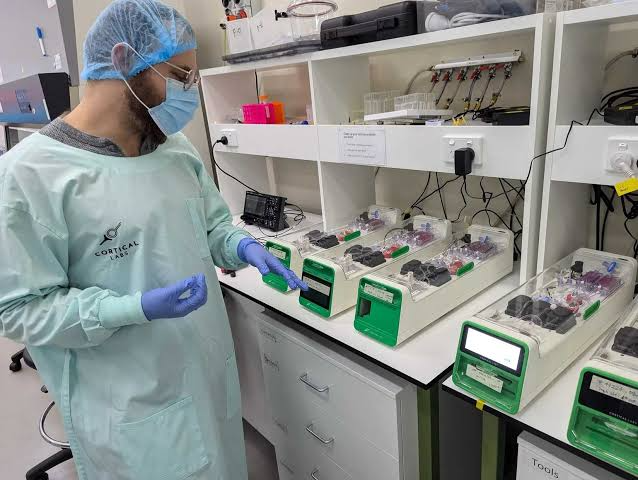
CL1 units being serviced. Each contains a life support system that pumps fresh nutrients to the neurons and keeps their environment stable for months at a time.
Cortical Labs’ DishBrain study showed that neurons grown in a dish could learn to play a simple game of Pong. Published in Neuron and featured in Nature.
Cortical Labs revealed the CL1 at Mobile World Congress in Barcelona, presenting it as a biological computer that researchers can program directly.
The CL1 became available to purchase, or to use remotely through the cloud, putting biological computing within reach of more labs.
The CL1 offers a way to study how cannabinoids affect human brain cells directly. In this study, neurons played Pong while dosed with TruCBN™ or THC.
“Cortical Labs has moved from foundational research to putting biological computing into the hands of researchers and developers.”
neurons living on each CL1 chip
response time between the neurons and the computer
how long the neurons can live on the chip
a fraction of the power used by conventional AI hardware
TruCBN™ reduced how often the neurons fired while their gameplay performance continued to significantly improve, suggesting a more focused response. Overall, TruCBN™ showed clear trends in improving performance in information-processing tasks at both doses tested, compared with THC or the control group, which did not show significant improvement.
drop in neuron firing rate one hour after dosing with TruCBN™ (5.0 μM). Control neurons were 5% lower over the same hour.
improvement in difficulty-weighted hit rate with TruCBN™ (5.0 μM). Control neurons were 4% lower by the end of each session.
improvement with TruCBN™ over control, adjusted for difficulty.
TruCBN™ improved performance at both low and high doses tested.
THC did not significantly improve firing rate or gameplay.
Fewer signals and better gameplay results suggest TruCBN™ may help neurons filter out background noise and focus their activity on the game.
Mean firing rate measures how active neurons are at rest, when they are not performing a task. TruCBN™ reduced firing rate at both doses compared with THC and the control group, with a significant reduction at the higher dose. THC did not significantly reduce firing rate compared to control.
Median % change from each culture's own pre-treatment baseline
Figure A. Change in culture mean firing rate. Redrawn from Figure 2.
Significance versus control by two-sided Mann-Whitney U with Holm-Bonferroni correction: ** p<0.01, * p<0.05.
The effect of TruCBN™ was sustained throughout the post-treatment and post-gameplay phases. Mean firing rate stayed well below baseline from one hour after dosing through the end of the night’s gameplay.
A tenfold lower dose of TruCBN™ (0.5 μM) also reduced baseline activity and retained improvements in gameplay. Further testing of concentrations between 0.5 and 5.0 μM will help define the optimal dose range.
Difficulty-weighted score measures how well neurons play as each hit makes the paddle smaller, making the game harder. TruCBN™ outscored THC and the control group at both low and high doses, suggesting a dose-dependent response. THC scores fell below control by the end of the gameplay session.
Group mean, four consecutive time segments of closed-loop gameplay
Figure B. Difficulty-weighted score across a gameplay session. Redrawn from Figure 3C.
All groups improved in early segments. By the final segment, TruCBN™ (5.0 μM) scored highest, while THC (5.0 μM) declined.
improvement with TruCBN™ over control, adjusted for difficulty.
The paddle started at 230 pixels and shrank to about 132 pixels by the end of each gameplay session. Weighting each hit by paddle size enabled difficulty-adjusted comparisons across groups.
A lower mean firing rate might be expected to reduce performance. Instead, TruCBN™-treated neurons kept improving across four segments of closed-loop gameplay, while the control group leveled off and THC declined, even as the shrinking paddle made the game harder.
One possible explanation is an improved signal-to-noise ratio. In other words, TruCBN™ may reduce random background firing while preserving the neurons’ response to the game. Additional research is needed to help clarify how TruCBN™ produces these effects.
TruCBN™ significantly reduced mean firing rate, both post-treatment and post-gameplay.
TruCBN™ improved gameplay performance beyond both the control group and THC, even as difficulty increased.
TruCBN™ was effective at both doses tested, with the strongest response at the highest dose tested.
Limited group size. Three treatment groups plus a control, set by limited access to CL1 systems.
Uneven testing time. TruCBN™ (5.0 μM) was tested for three days, all other groups for 14 days.
No pre-treatment gameplay. A gameplay baseline before dosing was not possible due to equipment access limitations.
Short-term effects only. Longer-term benefits, such as neuroprotective effects, were not studied.
Advanced tasks. Test TruCBN™ on tasks beyond Pong, such as symbol classification, to measure its effects on information processing in more detail.
Deeper analysis. Study how TruCBN™ affects patterns of activity across the neural network, using higher-order measures of neural function.
Extended treatment. Extend treatment with TruCBN™ to explore chronic effects, such as neuroprotection.

“This proof-of-concept study demonstrates for the first time that cannabinoids can change how isolated human neurons perform an information-processing task — the video game Pong.”
Figures are reproduced without modification from report CD001, generated by the Cortical Discovery analysis pipeline. Treatment codes: FW102, THC; FW104, TruCBN™ at 0.5 μM and 5 μM.
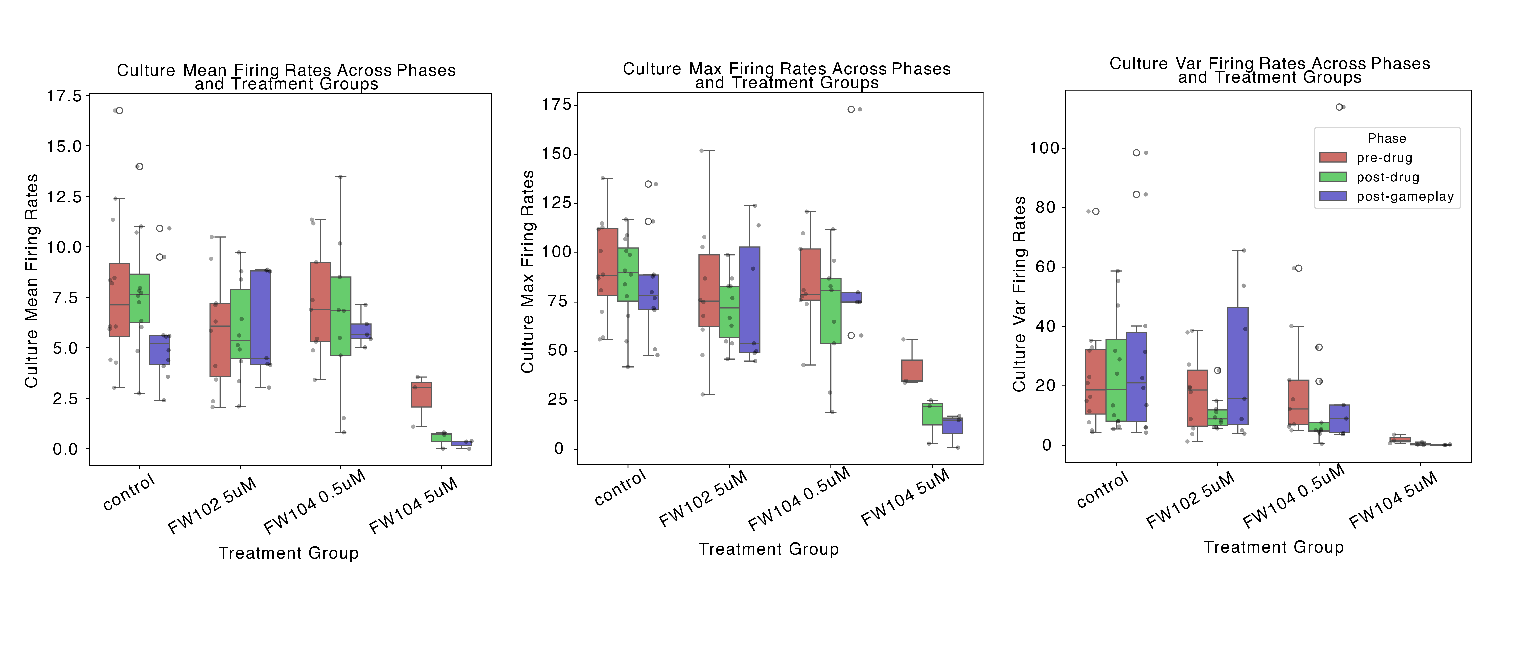
Figure 1. Evolution of firing rate statistics across experimental phases. Absolute mean, max and variance firing rates compared across pre-drug (red), post-drug (green) and post-gameplay (purple) phases, stratified by treatment group. Individual points are distinct recordings.
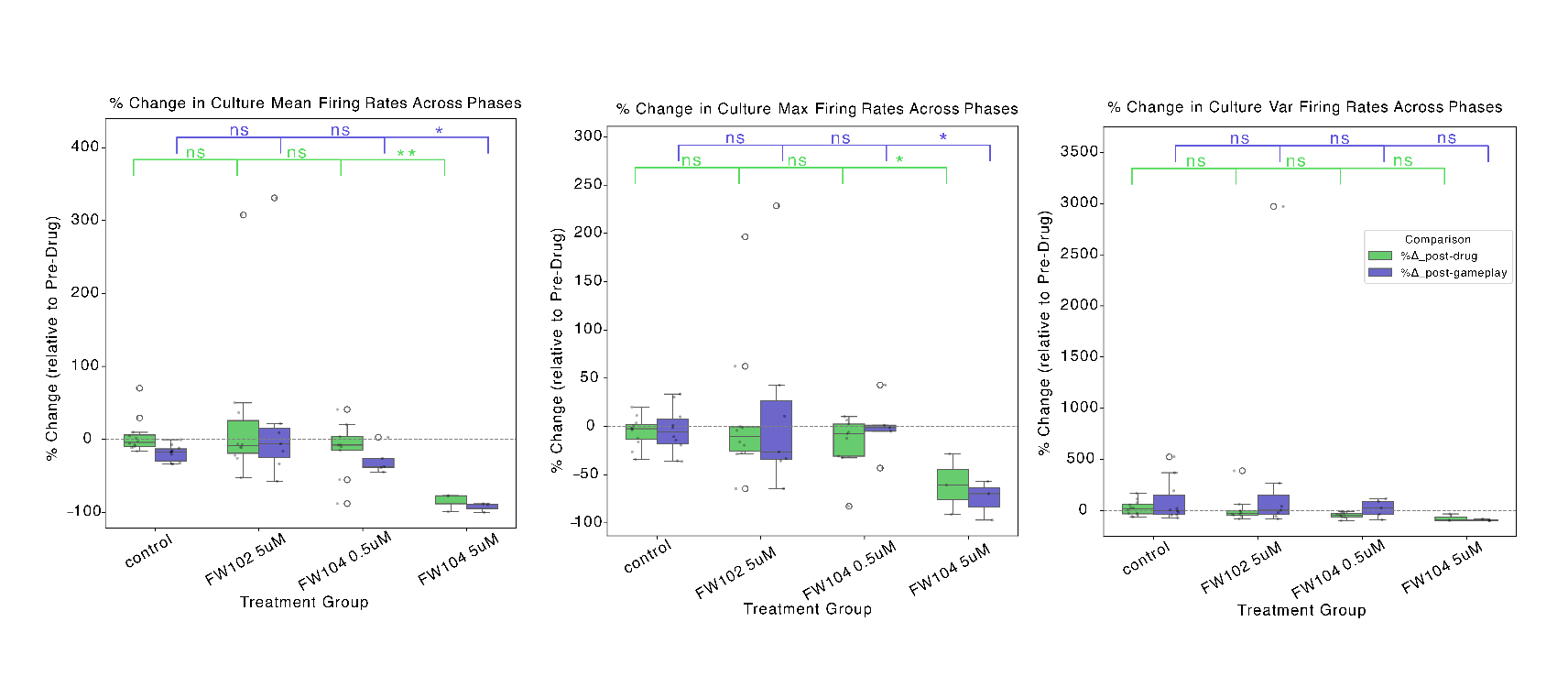
Figure 2. Percentage change in mean, max and variance of firing rates relative to each culture's pre-drug baseline. Treatments compared to control during the post-drug and post-gameplay windows; significance versus control indicated by asterisks (ns: not significant, * p<0.05, ** p<0.01).
Figures are reproduced without modification from report CD001, generated by the Cortical Discovery analysis pipeline. Treatment codes: FW102, THC; FW104, TruCBN™ at 0.5 μM and 5 μM.
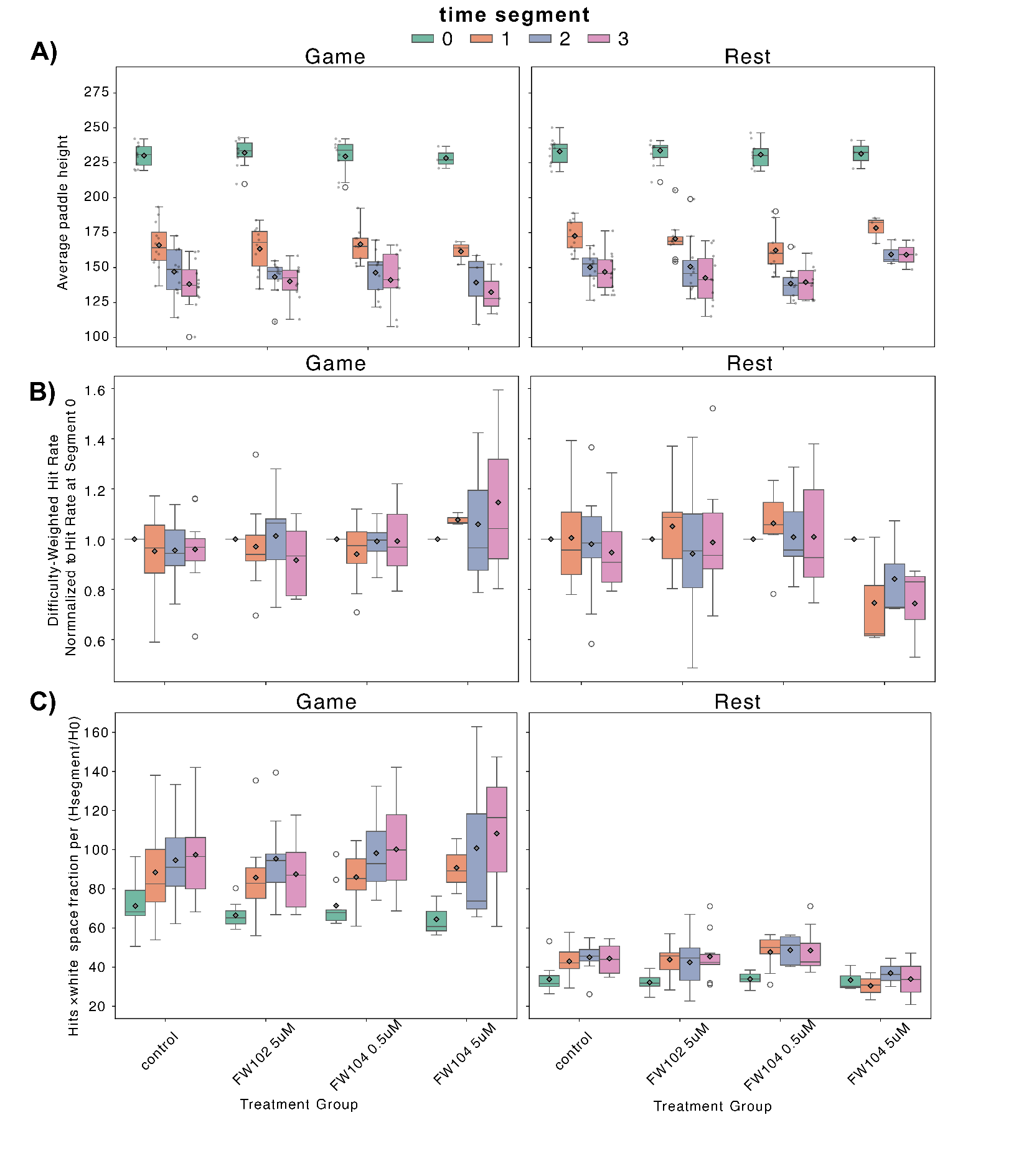
Figure 3. Temporal evolution of gameplay performance and adaptive difficulty across four time segments during Game (closed-loop) and Rest (spontaneous) sessions. A average paddle height, illustrating the adaptive difficulty mechanism. B difficulty-weighted hit rate, adjusted for paddle reduction. C difficulty-weighted score — hit count × white-space fraction. All normalised to the initial time segment.
Human iPSC-derived neural precursors plated on planar MEAs, differentiated to forebrain glutamatergic fate within 50 days.
Raw voltage traces filtered; spikes detected by threshold crossing. Firing rate in spikes per second (Hz).
Hit/miss ratio and paddle height, weighted for adaptive difficulty.
Two-sided Mann–Whitney U with Holm–Bonferroni correction, chosen for small sample sizes and non-parametric data.
Bioinformatic Analysis Report: Cannabinoid Efficacy — Compound Analysis FW104 vs FW102. Cortical Discovery Analysis Team, 2 December 2025. Report CD001, generated by the Cortical Discovery Analysis Pipeline.
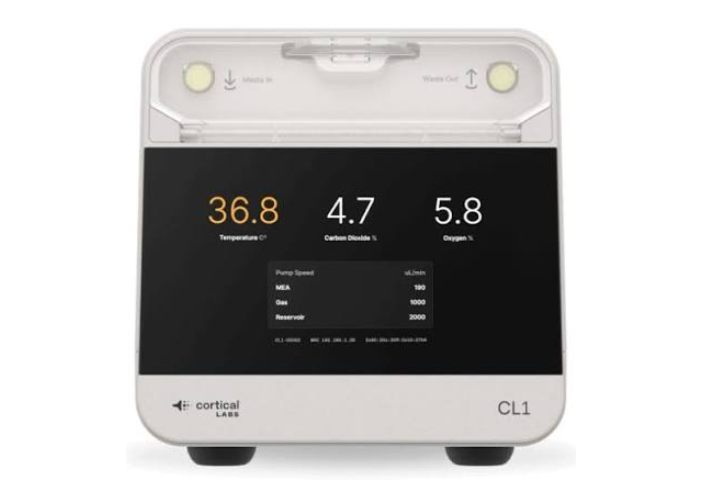
Cortical Labs is a Melbourne biotechnology company building Synthetic Biological Intelligence — living human neurons grown across silicon chips and addressed the way a computer is addressed. Its 2022 DishBrain study, published in Neuron and featured in Nature, showed cultured neurons learning to play Pong. In March 2025 it launched the CL1, the world's first code-deployable biological computer, shipping from that June and available remotely through the Cortical Cloud.

FloraWorks is a leading cannabinoid therapeutic development company specializing in high-quality, innovative products designed to improve health and wellness. With a focus on safety, efficacy, and consumer trust, FloraWorks is dedicated to unlocking the therapeutic potential of rare and novel cannabinoids, creating effective solutions that cater to a wide range of needs. FloraWorks’ flagship product TruCBN™ is clinically validated for sleep.
In vitro pilot data. Not a clinical claim. TruCBN™ is a FloraWorks ingredient; statements here have not been evaluated by the FDA and this material is not intended to diagnose, treat, cure or prevent any disease.